Archived entries for sustainability

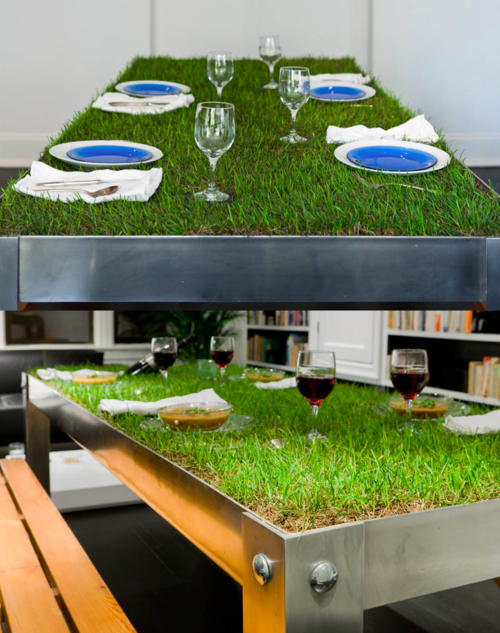
picNYC table

Ideal for vegetarians lol

“Ideal para vegetarianos aunque me parece que sobran los platos jeje”

picNYC TABLE by Haiko Cornelissen | Photos: Iwan Baan & Alan Tansey

Vía, inspire.2ia.pl

Parsonson Architects – Casa Shoal Bay

Parsonson Architects – Casa Shoal Bay

Casa-Shoal-Bay-Parsonson-Architects-archiblock_004

Shoal Bay es un asentamiento remoto en la accidentada costa este del sur de Hawkes. El edificio está diseñado para ser parte del entorno rural, se levanta del suelo y se situa a un costado del establo original, que ha servido a la bahía desde el 1900.

La vivienda es robusta pero acogedora a la vez y ofrece alojamiento sin pretensiones; es el tipo de lugar donde te quitas los zapatos y no debes preocuparte por ir dejando huellas de arena en el piso.

La vivienda está formada por dos pabellones ligeramente desplazados, uno destinado a las habitaciones y el otro al espacio de estar principal.
Se disponen terrazas en cada extremo del pabellón para el estar permitiendo seguir el sol en el transcurso del día.

Pantallas corredizas en el extremo nor-oeste proporcionan una protección para las diferentes condiciones del viento, privacidad de los vecinos campistas y actúa como paredes para dormir en el exterior.

English Version

Shoal Bay is a remote settlement in the rugged east coast of southern Hawkes. The building is designed to be part of the countryside, up from the ground and is located next to the original barn, which has served the Bay since 1900.

The housing is rugged yet cozy at the same time and offers unpretentious, it’s the kind of place where you take off your shoes and go do not worry about leaving traces of sand on the floor.

The house consists of two slightly displaced flags, one for rooms and one main living space.
Terraces are available at each end of the flag to be allowing to follow the sun during the day.

Sliding screens in the extreme northwest offering protection for different wind conditions, privacy from neighbors and act as walls campers to sleep outside.

Vía: cttmadera.cl

Casa-Shoal-Bay-Parsonson-Architects-archiblock_012 Casa-Shoal-Bay-Parsonson-Architects-archiblock_011 Casa-Shoal-Bay-Parsonson-Architects-archiblock_010 Casa-Shoal-Bay-Parsonson-Architects-archiblock_001 Casa-Shoal-Bay-Parsonson-Architects-archiblock

Continue reading…

All-in-one Lawn, battery and coffee table

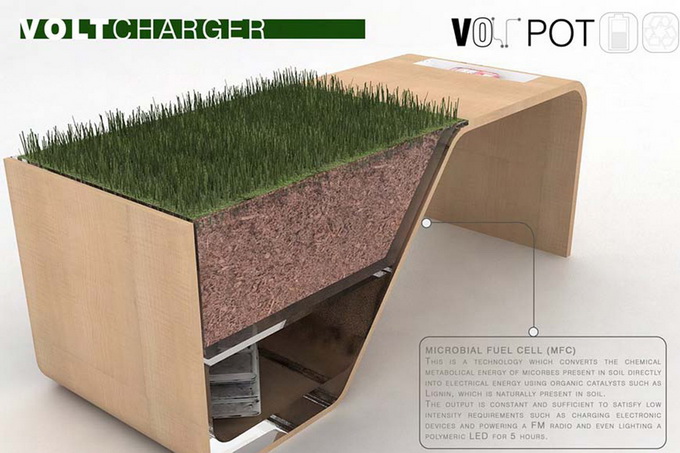
“Todo en uno” es lo que plantea esta mesa para café, incorporando césped y una fuente de energía novedosa.

Este es un diseño curioso que hace uso de una nueva tecnología llamada Voltpot, y que genera corriente  mediante los microbios que se hallan presentes en el césped, permitiéndote cargar tu móvil mientras disfrutas de un café.

all-in-one-lawn-battery-and-coffee-table-archiblock

Vía: vidafine.com

No parece fácil tener un césped que crece en tu sala de estar – pero lo que si, ese césped podría generar suficiente energía para cargar un teléfono celular. Y si ponemos esa idea en una mesa de café – y resultaría ser tan alarmante cuando alguien encuentra césped en tu sala de estar.

Tan difícil es creer que esa idea jamás puede ser posible, los chicos de Nectar Design han creado esta mesa de café que no sólo repone el oxígeno en su habitación con césped, sino también puede cargar su teléfono celular utilizando combustible microbiana Cell Technology.

Voltpot – La tecnología de pila de combustible microbiana es más o menos lo que suena – el poder se genera con el uso de microbios en el suelo de la hierba que se cultiva. Sí, los microbios, lo que significa que algo de comer a los microorganismos poco – típicamente agua enriquecida con nutrientes – y obtenemos la energía eléctrica hacia atrás. El poder es algo pequeño (~ 1 vatio por centímetro cúbico), pero es un flujo continuo de energía (a diferencia de viento o solar) que potencialmente pueden ser impulsados a algo como ~ 10W – suficiente para encender el iPhone.

English Version

It doesn’t seem straightforward having a lawn growing in your living room – but what if that lawn could generate enough power to charge a cellphone. And let’s mash that idea up into a coffee table – just so that it’s not so alarming when someone finds a lawn in your living room. As hard it is to believe that such an idea can ever be possible, the guys at Nectar Design have put together this coffee table that not only replenishes the oxygen in your room with grass, but it can also charge up your cell phone using microbial fuel cell technology. Say hello to the Voltpot.

Microbial fuel cell technology is more or less what it sounds like – power is generated with the use of microbes in the soil of the grass that is being grown. Yes, microbes, which means we feed the little microorganisms something – typically water enriched with nutrients – and we get electrical energy back. The power is somewhat small (~1 Watt per cubic centimeter), but it is a continuous stream of energy (unlike wind or solar) that may potentially be boosted up to something like ~10W – enough to power up your iPhone.

all-in-one-lawn-battery-and-coffee-table-archiblock_001 all-in-one-lawn-battery-and-coffee-table-archiblock_002

Arquitectura en barro en Bangladesh

Arquitectura en barro en Bangladesh

arquitectura-en-barro-bangladesh-archiblock

Vía: elchiltepe.com

Construido a mano en cuatro meses por los artesanos locales, alumnos, padres y profesores, esta escuela de primaria en Rudrapur, una aldea en el noroeste de Bangladesh.
Métodos y materiales de construcción tradicionales, pero los adapta de nuevas maneras. los arquitectos, Anna Aeringer de Austria y Roswag Eike de Alemania, hizo todo lo posible por participar las habilidades de los artesanos locales, ayudándoles a perfeccionar los procesos y aprender nuevas técnicas que luego podrían utilizar para mejorar el nivel general de la vivienda rural.

La filosofía del METI (educación moderna y centro de formación) es ir aprendiendo con alegría.
Los profesores ayudan a los niños a desarrollar su propio potencial y usarlo de una manera creativa y de manera responsable.
El edificio refleja estas ideas a través de sus materiales, las técnicas
y diseño arquitectónico.

La solución de diseño utilizado en este pueblo rural no puede ser replicable en otras partes de la República Islámica mundo ya que las condiciones locales varían. Sin embargo, las nuevas soluciones de diseño pueden surgir de un análisis en profundidad del conocimiento del contexto local y nuevas formas de construcción. esto proporciona un nuevo y esperanzador
modelo para la construcción sostenible a nivel mundial. el resultado final de este esfuerzo de los voluntarios heroicos es un edificio que crea belleza, espacios colectivos y humanas significativas para el aprendizaje que enriquecen las vidas de los niños que atiende.

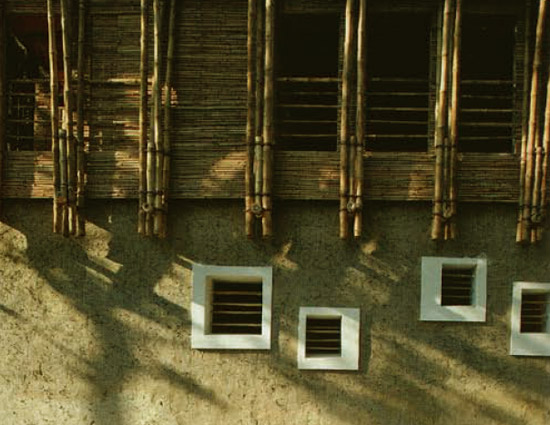
El método de construcción utilizado es una técnica en tierra, ésta, mojada se mezcla con paja y se aplica a la pared en capas. Cada capa es de aproximadamente 50-70 cm de alto, y después de un par de días de secado, que se recorta a los lados con una pala afilada para obtener una superficie regular de pared plana.
Después de un segundo período de secado, una capa más se puede añadir. la tierra en esta región está bien preparada; de tal construcción y la estabilidad de la mezcla fue mejorada por la adición de arroz, paja.

El techo está formado por tres capas de varas de bambú dispuestas perpendicularmente a un
otra con el embarque de bambú y una tierra de relleno en la superficie del suelo.
La misma construcción en forma modificada puede ser usado para los edificios de viviendas en general

English version

hand-built in four months by architects, local craftsmen, pupils, parents and teachers,
this primary school in rudrapur, a village in north west bangladesh, uses traditional
methods and materials of construction but adapts them in new ways. the architects,
anna aeringer from austria and eike roswag from germany, made every effort to engage
the skills of local craftsmen, helping them refine processes and learn new techniques
that they could then use to improve the general standard of rural housing.

the philosophy of METI (modern education and training institute) is learning with joy.
the teachers help the children to develop their own potential and use it in a creative
and responsible way. the building reflects these ideas through its materials, techniques
and architectural design.

the design solution used in this rural town may not be replicable in other parts of the islamic
world as local conditions vary. however, new design solutions can emerge from an in-depth
knowledge of the local context and new ways of building. this provides a fresh and hopeful
model for sustainable building globally. the final result of this heroic volunteer effort is a building
that creates beautiful, meaningful and humane collective spaces for learning which enrich
the lives of the children it serves.

the construction method used is a historical earth building technique similar to cob-walling
which is ideal for ‘self building’. the wet earth is mixed with straw and applied to the wall
in layers. each layer is approximately 50-70 cm high, and after a couple of days drying,
it is trimmed on the sides with a sharp spade to obtain a regular flat wall surface.
after a second drying period, a further layer can be added. the earth in this region is well-suited
for such construction and the stability of the mixture was improved by adding rice, straw and jute.

earth construction: the most important technical improvement in comparison to traditional
buildings is the introduction of a damp proof course and a brick foundation. the traditional
building technique (which uses very wet earth) has been replaced by the ‘weller’ technique
that is quite similar to the traditional one.

arquitectura-en-barro-bangladesh-archiblock_017 arquitectura-en-barro-bangladesh-archiblock_014 arquitectura-en-barro-bangladesh-archiblock_012 arquitectura-en-barro-bangladesh-archiblock_010 arquitectura-en-barro-bangladesh-archiblock_009

Depósito para canoas, Arquitectura en España

Edificio para alojar canoas en españa, diseñado por Julio Barreno

A nuestro entender es una obra que guarda mucho respeto con su entorno inmediato, que toma consideraciones paisajísticas y las incorpora al lenguaje formal.

Depósito para canoas, Arquitectura en España

Depósito para canoas, Arquitectura en España

Vía: coolboom.net

Julio Barreno | Arquitecto

Se proyecta un edificio para el almacenamiento de canoas como otro punto blanco en el paisaje del Zahara de la Sierra, un pequeño pueblo en el sur de España.

He aquí la descripción del proyecto:

Zahara de la Sierra es un pequeño pueblo en el sur de España. El paisaje está conformado por pequeñas piezas blancas de la vivienda basado en el pequeño tamaño de las parcelas. La vista aérea de este paisaje se define por los píxeles verdes y blancos de las propiedades en esta área.

Esta capacidad para el almacenamiento de las canoas se construye como otro punto blanco en el paisaje.

Tres líneas definen la situación exacta del proyecto en el sitio: La estrecha carretera que va de la secundaria al nivel del agua, la línea de alta tensión que cruzan la parte superior del sitio, y el nivel del embalse de agua de inundación.

Estas condiciones, junto con otras, como el suelo malo para las fundaciones, condicionaban el partido del proyecto.

El edificio es un BY-PASS, conecta el estacionamiento, al comienzo de la carretera secundaria, con el muelle, a nivel del agua, por lo que la propuesta es de un camino entre estos dos puntos. La gente ingresa a través de la entrada de huéspedes en su ropa de diario, y sale por el otro lado con la canoa y ropa deportiva en su camino hacia el agua. En este sentido, el edificio se convierte en un intercambiador, como tope, de un alto en el camino.

Para la construcción de este elemento, se utilizó el material predominante de esta zona, el color blanco como el ingrediente principal e inclinando el techo de tejas color negro con algunos tragaluces blancos diseminados. Estas características confieren al edificio un carácter determinado en el paisaje.

De esta manera, el edificio surge como otro elemento blanco en el espíritu del paisaje nativo de esta región.

English version

Julio Barreno | Arquitecto projected a building for storage of canoes as another white point in the landscape of Zahara de la Sierra, a small village in the south of Spain.

Here is the project description:

Zahara de la Sierra is a small village in the south of Spain. The landscape is shaped by small white pieces of housing based on the small size of the plots. The aerial view of this landscape is defined by the green and white pixels of the properties in this area.

This building for storing canoes is built as another white point in the landscape.

Three lines define the project’s exact situation in the site: The narrow road going from the secondary one to the water level, the overhead power line crossing the upper part of the site, and the reservoir’s flood water level.

These conditions, along with others, like the bad ground for foundations, decide what the building becomes.

The building is a BY-PASS connecting the parking lot, at the beginning of the secondary road, with the jetty, at water level, so the proposal designs a path between these two points. People get in through the guest entry in their everyday clothes, and leave through the opposite exit with the canoe and sports clothes on their way to the water in the reservoir. In this sense, the building becomes an INTERCHANGER, as a stop, a halt in the path.

For the construction of this element, we used the prevalent materials of this area; white color as the main ingredient and inclined black tiled roof with some white disseminated skylights. These characteristics give the building a certain landscape character. It could be called a BUILDING-LANDSCAPE, a CANOES LANDSCAPE.

In this way, the building emerges as another white element in the spirit of this region’s native landscape.

Canoes-landscapes-architecture_006 Depósito para canoas, Arquitectura en España Canoes-landscapes-architecture_004 Canoes-landscapes-architecture_003 Canoes-landscapes-architecture_002 Canoes-landscapes-architecture_001 Canoes-landscapes-architecture Canoes-landscapes-architecture_007

Kurreki House por Bourne Blue Architecture

Kurreki House by Bourne Blue Architecture

Una casa para vacaciones diferente.

The-Kurreki-House-by-Bourne-Blue- Architecture_006

Architect – Bourne Blue Architecture

Vía contemporist.com

Seal Rocks es un pueblo pequeño y único, muchas viviendas existentes son básicas chozas de pesca, ahora utilizas sobre todo para las vacaciones.

La intención era construir una casa de vacaciones sin complicaciones, que también podrían ser liberados para la renta de alquiler. El enfoque era construir de una manera que conserva el lenguaje de las formas existentes construidas de Seal Rocks y ser respetuoso de contexto.

Hay un ligero aumento en el sitio en la parte trasera y una perspectiva para el monte, delante y detrás. El Servicio de Bomberos Rural colocó un revés 10m en la parte posterior, forzada una valla de fuego y le dictó que todos los edificios de la calle tenían que ser parcialmente zona de flama y el nivel 3 de protección incendios forestales.

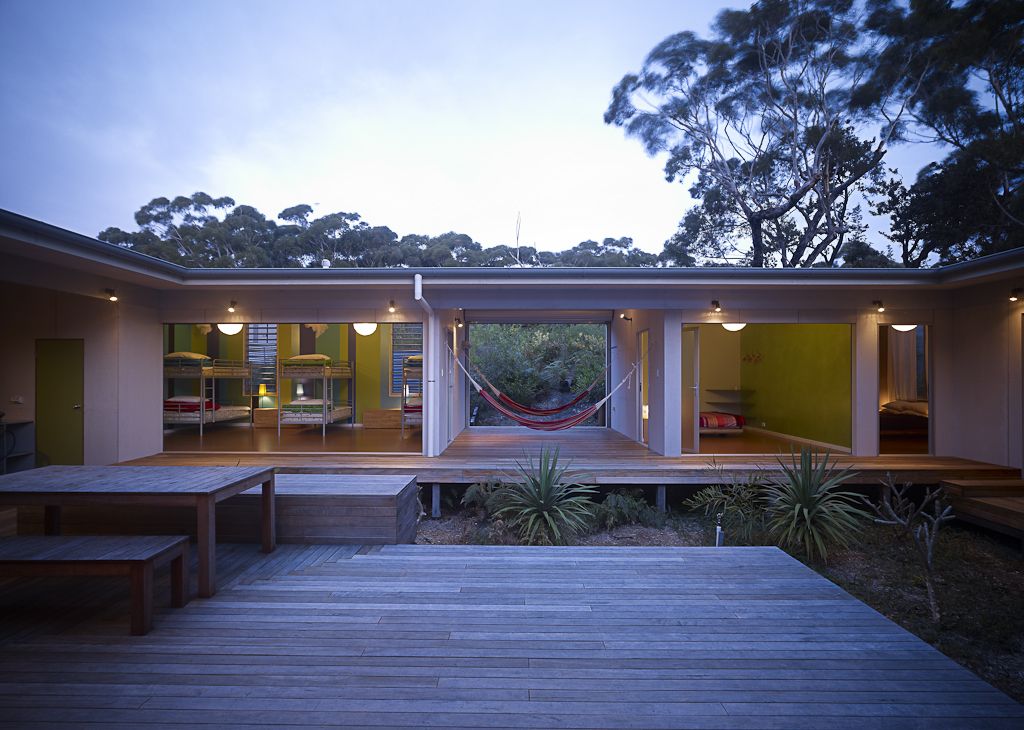
El edificio se centra en el espacio central para minimizar la cantidad de cristales exteriores reduciendo así la cantidad de tratamientos costosos. Se mejora el sentido de la vida privada y anexo a la sala de estar al aire libre. El borde que rodea el techo interno permite la circulación protegida bajo el alero, reduce la forma construida y oscurece los interiores y de transición al aire libre. También enmarca una visión del cielo que está animada por la noche por la luz de un faro que pasa por encima.

Kurreki ‘nombre’, (‘Myrtle Bush “en la lengua Worimi), la sensación de la casa es uno de los camping de lujo. Ser capaz de cerrar el perímetro exterior hace que todas las habitaciones se pueden abrir a la cubierta central. Esto le permite dormir bajo mosquiteros, con vistas del cielo nocturno. Un amplio vestíbulo de entrada sombreada es para el almacenamiento de tablas de surf, colgando toallas y trajes de neopreno, mientras una lluvia de arena cercanasse extiende  por toda la casa. El espacio más popular es la cubierta de hamaca a la sombra, que recibe uso constante.

Materiales que buscan relacionarse con el contexto de la aldea, son económicos y resistentes a la corrosión. No hay <materias ciudad> como splashbacks vidrio, cerámica o piedra pulida. Las paredes están cubiertas con revestimiento de 9 mm de CFC y canales de aluminio, al igual que los edificios existentes de fibra. Localmente decking blackbutt blanqueado y techos orbe personalizados son otros materiales dominantes, tanto de los cuales se utilizan en los edificios existentes. Los métodos de construcción y los detalles son intencionadamente básicos, por razones de economía y de trabajo con los comerciantes locales. El acero se trata de evitar y elementos como el sistema de alumbrado exterior sion de plástico, y fueron elegidos tanto por la economía como por su la larga vida.

Los pisos son de partículas de pulido, carpintería de todos los usos formply . El exterior es simple, gris y plata, mientras que el interior está lleno de color, inspirada en rockpools y la vecina selva.

Una granja de humedad trata de aguas residuales, el techo se alimenta y 27000 litros de almacenamiento de agua para uso doméstico, con un 15000L adicionales para lucha contra incendios. Para una protección adicional de una bomba suministra los rociadores contra incendios en la cobertura y el nivel de jardín con la oferta interna. Algunas de estas tierras en el techo, a continuación, vuelve a circular, que se extiende el tiempo de protección.

English version

The Kurreki House by Bourne Blue Architecture

Seal Rocks is a small, unique village, many existing dwellings are basic weatherbeaten fishing shacks, now mostly used for holidays. Thomas road, was developed later and the last 10 blocks in the street only became available in 2003.

The intention was to build an uncomplicated holiday house, which could also be let out for rental income. The existing original cottages are slowly being lost as properties change hands, so the approach was to build in a way that retains the language of the existing built forms of Seal Rocks and to be respectful of context.

There is a gentle rise on the site to the rear and an outlook to the bush, front and rear. The Rural Fire Service placed a 10m setback to the rear, enforced a fire fence and dictated that all the buildings in the street had to be partly flame zone and level 3 bushfire protection.

The building focuses to the central space to minimise the amount of external glazing thus reducing the amount of expensive bushfire treatments. It improves the sense of privacy and enclosure to the outdoor living area. The surrounding internal roof edge allows protected circulation under the eaves, reduces the built form and blurs the indoor/outdoor transition. It also frames a sky view which is animated at night by the lighthouse beam passing overhead.

Named ‘Kurreki’, (‘Bush Myrtle’ in the Worimi language), the feel of the house is one of luxury camping. Being able to close the outer perimeter makes all rooms openable to the central deck. This allows you to sleep under mosquito nets, with a view of the night sky. A wide shaded entry foyer is for storage of surfboards, hanging towels and wetsuits while a shower nearby reduces sand spreading throughout the house. The most popular space is the shady hammock deck, which receives constant use.

Materials throughout relate to the context of the village, are economical and corrosion resistant. There are no ‘city’ materials like glass splashbacks, ceramic tiles or polished stone. The walls are lined with 9mm CFC cladding and aluminium channels, much like the existing buildings of fibro and cover batten. Locally milled blackbutt decking and custom orb roofing are other dominant materials both of which are used in existing buildings. Construction methods and detailing are intentionally basic, for reasons of economy and working in with the local tradesmen. Steel is avoided and items such as the plastic external light fittings, were chosen both for economy and long life. Floors are polished particleboard, all joinery uses formply as a finished face. The exterior is simple, grey and silver, while the interior is colourful, inspired by rockpools and neighbouring bush.

A wet composting worm farm treats sewage, the roof feeds to  27000 L of water storage for domestic use, with an additional 15000L for firefighting. For extra  protection a pump supplies the fire fighting sprinklers at roof and garden level with the domestic supply. Some of this lands on the roof, then recirculates, extending the protection time.

The-Kurreki-House-by-Bourne-Blue- Architecture_005 The-Kurreki-House-by-Bourne-Blue- Architecture_004 The-Kurreki-House-by-Bourne-Blue- Architecture_003 The-Kurreki-House-by-Bourne-Blue- Architecture_002 The-Kurreki-House-by-Bourne-Blue- Architecture_001 The-Kurreki-House-by-Bourne-Blue- Architecture The-Kurreki-House-by-Bourne-Blue- Architecture_007

Casa de Té circular por Compost

circular-pod-tea-house-is-heated-by-compost

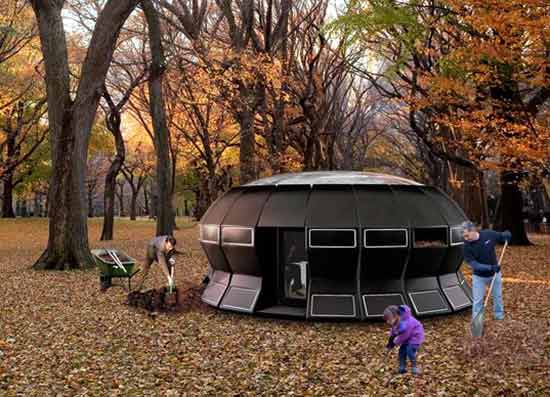
Con título provisional  “Comploo”, la pequeña estructura Bakoko se compone de una serie de grandes tolvas de forma especial dispuestas en un anillo para formar un recinto.

Para alimentar el conjunto, los residuos de jardín, restos de comida o materiales se puede eliminar a través de una puerta en la parte superior de cada grupo.

Un sistema de conductos cerrados corre a través de cada uno de los contenedores, y como el aire que circula dentro de las paredes, el abono en descomposición calienta. Este aire caliente es a su vez emite a través de una chimenea central que las emisiones en el interior de la estructura. Los ocupantes pueden sentarse cómodamente a lo largo de un banco circular que rodea la fuente de calor, y disfrutar de la luz natural ambiente que permea a través del techo de cúpula transparente de arriba.

circular-pod-tea-house-is-heated-by-compost_002 circular-pod-tea-house-is-heated-by-compost_001 circular-pod-tea-house-is-heated-by-compost_003

Tentatively named “Comploo,” Bakoko’s small structure is composed of a series of large, specially shaped compost hoppers arranged in a ring to form an enclosure. To feed the composter, garden waste, food scraps or other compost materials can be dropped in through a door at the top of each bin.

A system of sealed ducts runs through each of the bins, and as the air circulates within the walls, the decaying compost warms it. This heated air is in turn emitted through a central vent that releases into the structure’s interior. Occupants can comfortably sit along a circular bench surrounding the heat source, and enjoy the ambient natural light permeating through the transparent dome roof above.

Casa en Koamicho por Suppose Design Office

Casa-Koamicho-por-Suppose-design-office_002

Los arquitectos japoneses Suppose Design Office han completado una casa en Hiroshima, Japón, donde los residentes se mueven entre habitaciones a través de patios cubiertos.

Casa que llamada Koamicho, es residencia de dos plantas y está situada en una parcela larga y estrecha.

English text at the end

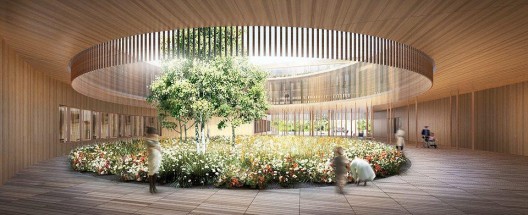
Dos plazas de cristal entre las habitaciones están plantadas con árboles pequeños y procuran romper la sucesión de habitaciones, ofreciendo visiones del exterior.
Los dormitorios están ubicados en la planta baja con cocina, comedor y salas de estar en el primer piso.

Casa-Koamicho-por-Suppose-design-office_013 Casa-Koamicho-por-Suppose-design-office_012 Casa-Koamicho-por-Suppose-design-office_011 Casa-Koamicho-por-Suppose-design-office_010

La siguiente información es de Suppose Design Office :

Casa en Koamicho

Cuando normalmente se dice “interior” o “exterior”,
¿cuáles son las causas? ¿Y cuáles son las causas de la sensación de “abierto” o “estrecho”?

Esta casa está diseñada con mucha atención a cómo, desde las causas, se definen las condiciones de un espacio.

En un espacio largo y estrecho, construimos muros, y por un espacio en el que experimentamos muchas habitaciones, que a su vez “estrechez” en “la apertura.
“Además, teniendo en habitaciones y jardines como equivalentes, hemos creado espacios que son como los exteriores, llamándolos” salas de jardín “.

Casa-Koamicho-por-Suppose-design-office_009 Casa-Koamicho-por-Suppose-design-office_008 Casa-Koamicho-por-Suppose-design-office_007 Casa-Koamicho-por-Suppose-design-office_006 Casa-Koamicho-por-Suppose-design-office_005 Casa-Koamicho-por-Suppose-design-office_004

Al cambiar de habitación a otra habitación, alternativamente, puede experimentar el interior y exterior, y se convierten en el lugar donde todas las habitaciones están conectados con el exterior.
Aquí hemos tenido éxito en la realización de un espacio, que pasan de las definiciones tradicionales  una nueva relación entre – interior y exterior.

Japanese architects Suppose Design Office have completed a house in Hiroshima, Japan, where residents move between rooms through covered courtyards.

Called House in Koamicho, the two-storey residence is situated on a long narrow plot.

Two glazed spaces between rooms are planted with small trees and break up the succession of rooms, affording glimpses of the outside.
Bedrooms are located on the ground floor with kitchen, dining and living areas on the first floor.

Vía dezeen.com
The information below is from Suppose Design Office:

House in Koamicho

When we normally feel “interior” or “exterior”, what are the causes? And what are the causes of feeling “open” or “narrow”?
This is house designed with much thought to how, from those root causes, we define the conditions of a space.

In a long, narrow space, we constructed walls, and by laying out a space in which we experience many rooms, we turn “narrowness” into “openness.
“Further, taking rooms and gardens as equivalent, we created spaces that are like the exteriors, calling them “garden rooms”.

By moving from room to another room, we can alternately experience interior and exterior, and they become the place where every rooms are connected to the exterior.
Here we have succeeded in realizing a space, which pass traditional definitions tomaterialized a new relationship between – interior and exterior.

Casa-Koamicho-por-Suppose-design-office_003 Casa-Koamicho-por-Suppose-design-office_001 Casa-Koamicho-por-Suppose-design-office Casa-Koamicho-por-Suppose-design-office_014