Archived entries for Arquitectura Universidad

Mirador “Evolver” en Zermatt, Suiza.

evolver-by-students-from-alice-studio

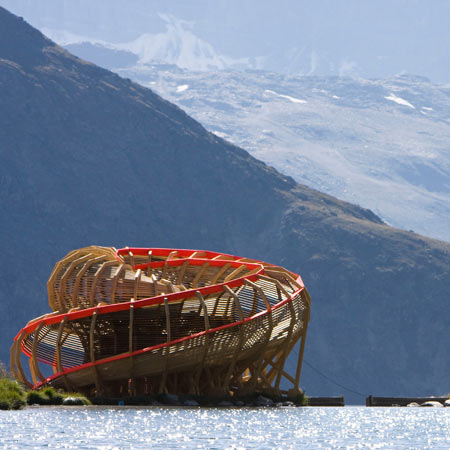
Los estudiantes del estudio de ALICE en la Escuela Politécnica Federal de Lausana han desarrollado una estructura de madera para la observación del entorno junto a un lago en Zermatt, Suiza.

Llamado Evolver, la estructura consta de 24 cuadros de madera dispuestas formando un tubo que los visitantes pueden moverse a través de ella, viajando 720 grados en torno al eje de la estructura antes de llegar de nuevo al punto de inicio.

evolver-by-students-from-alice-studio_006 evolver-by-students-from-alice-studio_005

Vistas del paisaje circundante que están enmarcadas por rendijas entre los soportes.

Aquí hay más información de los estudiantes:

evolver-by-students-from-alice-studio_004
Evolver

Evolver es un artefacto arquitectónico que interviene en el panorama circundante de Zermatt.

Fue diseñado y ejecutado por un equipo de estudiantes de 2 º año a partir del estudio de Alice en la EPFL en Lausanne, Suiza. En un esfuerzo por aprovechar al máximo los puntos de vista amplios y sorprendentes del sitio, el proyecto se encuentra estratégicamente junto al lago Stelli a una altitud de 2536m.

Su estructura se compone principalmente de una sucesión de 24 bastidores de soporte giratorio configurando un espacio cerrado que invita a entrar a los visitantes. Avanza a través del espacio, un oculto, pero ininterrumpido 720 ° de movimiento se está deshaciendo a lo largo de un panorama transformado.

evolver-by-students-from-alice-studio_007 evolver-by-students-from-alice-studio_003 evolver-by-students-from-alice-studio_002

evolver-by-students-from-alice-studio_001

Students of the ALICE studio at Ecole Polytechnique Fédérale de Lausanne have built a wooden structure for viewing the surroundings next to a lake in Zermatt, Switzerland.

Called Evolver, the structure consists of 24 wooden frames arranged to form a tube that visitors can move through, travelling 720 degrees around the structure’s axis before arriving back to the start again.

Views of the surrounding landscape are framed by slits between the supports.

Here’s some more information from the students:

EVOLVER

Evolver is an architectural artefact intervening on the panorama surrounding Zermatt.

It was designed and executed by a team of 2nd year students from the ALICE studio at the EPFL in Lausanne, Switzerland. In an effort to take full advantage of the site’s extensive and astounding views, the project sits strategically next to the lake Stelli at an altitude of 2536m.

Its structure mainly consists of a succession of 24 rotating frames supporting an enclosed space that visitors are encouraged to enter. As he or she progresses through the space, a concealed but uninterrupted 720° movement is unravelling along a transformed panorama.

This transformation occurs while inside a person is moving along a selective string of openings only to be caught peeling off a sequence of unexpected views from the original landscape.

Wobbling below and above a distant horizon, ground and sky have been reorchestrated into an orbiting panorama by a journey that has already culminated to where it started: A loophole on the skyline.

Vía: dezeen.com

Facultad de arte y arquitectura en Évora, Portugal.

Facultad-de-artes-y-arquitectura-ines-lobo-ventura-trindade_001

“Los edificios están diseñados en torno a las máquinas, y no alrededor de personas, en términos físicos o trascendentales, que son reducidos a meros operadores, trabajadores, simples engranajes de la máquina.”

Visto desde la distancia del centro histórico y el enfoque en la dirección de la fábrica Leões, permite comprenderse que, curiosamente, su valor principial consiste en su volumen excesivo que se impone abruptamente en la meseta.

Facultad-de-artes-y-arquitectura-ines-lobo-ventura-trindade Facultad-de-artes-y-arquitectura-ines-lobo-ventura-trindade_004

Los anexos que no formaban parte de la construcción original fueron eliminados, al igual que toda la construcción provisional en el edificio. La naturaleza espacial de los edificios se hizo evidente.

Un edificio se añade que los sustitutos de los anexos, por lo tanto la configuración del nuevo patio, con talleres asociados, una cafetería y un cobertizo. Otras infraestructuras se añadieron a los espacios existentes, que proporcionan las instalaciones necesarias para la enseñanza, y mobiliario complementario.

Facultad-de-artes-y-arquitectura-ines-lobo-ventura-trindade_002 Facultad-de-artes-y-arquitectura-ines-lobo-ventura-trindade_008

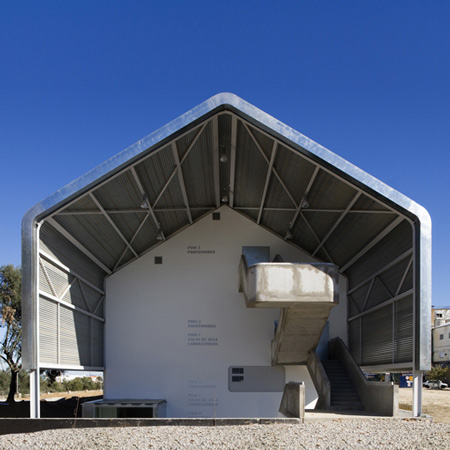
Con el conocimiento creciente de los antiguos espacios industriales y los sistemas se encuentran algunas de las estrategias para su reutilización en la construcción de las escuelas. Primero están los grandes cubiertas que protegían a la plataforma ferroviaria y la carga y otras zonas de descarga, el cual difícilmente podría cambiar más en su delicada ligereza con la enorme masa de las construcciones.

Facultad-de-artes-y-arquitectura-ines-lobo-ventura-trindade_007 Facultad-de-artes-y-arquitectura-ines-lobo-ventura-trindade_005

Ahora volver a introducir; alberga a los profesores y los estudiantes en lugar de productos y materias primas, la construcción del lugar de reunión del conjunto de la escuela, que resume el patio principal se establece una relación visual entre todos los espacios del conjunto, cuyo espacio central abierto es uno inesperado campo verde que recuerda a los campus universitarios, hasta entonces tan distantes de este contexto.

Este cuerpo se conecta a los diferentes elementos en el mismo tiempo que construye el espacio de la escuela, un amplio atrio y alargado, una especie de columna vertebral que permite a los organismos que antes estaban aisladas a funcionar una vez más, pasando a formar parte de una sola estructura.

Fotografías de Leonardo Finotti

Enlaces:

Inês Lobo Arquitectos

Ventura Trindade Arquitectos.

Refurbished for the Universidade de Évora, the project involved removing more recent annexes from the original buildings, reconfiguring interior spaces and adding new infrastructure.

Structures originally used to shelter railway platforms have been re-appropriated to join separate buildings together.

Seen from a distance from the historic centre and the approach in direction of the old Leões factory allows one to understand that, oddly enough, its principle value consists of its excessive volume that is imposed abruptly on the plateau.

Buildings designed around the machines they would house, and not around people, in physical or transcendental terms, who are reduced to mere operators, workers, simple cogs in the machine.

Original programme – Built in 1916, the Alentejo Milling Society became the Leões pasta factory in the 1970s.

A partially occupied but machine-less building, appropriated by man. Spaces that, due to their versatility and relationship with the territory, became places for teaching.

New programme – University of the arts, department of visual arts and department of architecture

The annexes that were not part of the original construction were removed, as were all provisional construction inside the building. The spatial nature of the buildings became clear.

A building is added that substitutes the annexes, thus configuring the courtyard afresh, with associated workshops, a cafeteria and a lean-to. Other infrastructures were added to the existing spaces, which provide the necessary facilities for teaching, and extra furniture.

With increasing knowledge of old industrial spaces and systems we find some of the strategies to reuse in the construction of the schools. First are the large coverings that protected the railway platform and other loading and unloading areas, which could hardly contrast more in their delicate lightness with the enormous mass of the constructions.

Now re-introduced, it shelters teachers and students instead of products and raw materials, constructing the meeting place of the school ensemble, it outlines the main patio establishing a visual relationship between all the spaces of the ensemble, whose central open space is an unexpected green field which is reminiscent of university campuses, until then so distant from this context.

Vía: dezeen.com