Archived entries for Arquitectura Latinoamericana

Snow House – Arquitectura en chile

snow-house-arquitectura-chilena

snow-house-arquitectura-chilena

“Hoy en día el concepto de desarrollo sostenible es cada vez más un grave problema de diseño arquitectónico, frente al calentamiento global, sino también a la explotación exponencial de energía.”

“Por desgracia, es común encontrar que las respuestas a este problema están más en la aplicación de técnicas sobre estrategias arquitectónicas tradicionales o en el desarrollo de tipologías originales pero formateadas y separadas del contexto, y de sus oportunidades y desventajas inherentes.”

English text at the end

Sitio :  nicolasdorvalbory.com

“Bajo el proyecto de la casa de Xella, hemos querido abordar concretamente estos dos temas, a saber, crear una nueva tipología arquitectónica, derivándose simultáneamente de uno funcionamiento técnico y de las características del sitio y del programa. Uso de la gama de ladrillos de hormigón celular Xella, hemos desarrollado una estrategia sencilla para aprovechar el material al mejor de acuerdo a sus diferentes propiedades.

planta nicolas 2 Layout1 (1) snow-house-por-nicolas-dorvalbory

Caso
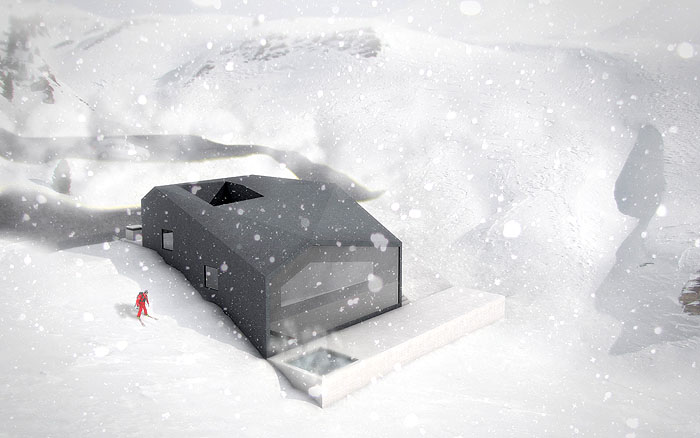
El programa es un refugio de montaña, ubicado en un terreno escarpado. Con una eficiencia funcional y energética ejemplar, este tipo de hábitat es una referencia indispensable para un proyecto así, en lugar de una más tradicional segunda casa en los cerros. Como un refugio o un “chalet” tradicional, nuestro proyecto se inscribe y se ancla en el sitio, principalmente para protegerse del frío que puede ser particularmente fuerte en los cerros de Santiago. Cuya función es dar cabida a los ocupantes (que participan en el día en los deportes de invierno), el refugio tiene que ser un lugar amigable y cálido, pero simple fácil de usar, ya que él diseñó esa comida y descanso.

Layout
Así, el proyecto se organiza en un plano cuadrado, lo que permite flexibilidad de uso y eficiencia de la arquitectura. Este diseño compacto permite la optimización máxima de los bloques Xella, sino también un muy bajo coeficiente de pérdida de calor. Para retener el calor máximo, la casa se implanta más cercana a la tierra, sin voladizo. El patio central está diseñado como un buffer space, generando un cambio en la organización del programa y al mismo tiempo permitiendo una importante contribución de luz natural y de aire fresco en verano. La casa entera es también realmente pensada como un clima completo. La orientación hacia el norte, una capa de mezcla gruesa negra y sistemas pasivos de calentamiento generan una atmósfera interior muy agradable en invierno. La distribución funcional de los espacios está organizada de acuerdo a la temperatura más adecuada para cada actividad, jugando con la organización concéntrica del programa y diferentes niveles permitidos por la pendiente del terreno.

snow-house-por-nicolas-dorvalbory_001

Layer
Este principio conduce a un salón y cocina mirando hacia el norte con un gran ventanal, entonces se llega a las habitaciones y, finalmente, los cuartos de baño, con rumbo sur pero con temperatura interior elevada. Las funciones básicas se agrupan también en el centro de la casa, más caliente, dando lugar a los lados este y oeste. Aquí, las escaleras de servicio permiten que el aire circule libremente. En la forma de una manga de ropa, el plan de la casa es concebida como una sucesión de capas, layers de propiedades variadas dependiendo de los requisitos de aislamiento térmico. Así, la separación dormitorios/living está garantizada sólo por una cortina espesa de fieltro, apuntando a el trabajo (y la propia historia) de Joseph Beuys, mientras que el patio o las paredes exteriores utilizan diversos tipos de bloques de Xella, además de una capa impermeable aislamiento.

Paisaje térmico
Para calentar la casa, hemos utilizado dos sistemas pasivos acoplados:
- Bomba de calor geotérmica: el aire fresco esta bombeado fuera de la casa, lado sur, se filtra y luego fluye a través de una tubería subterránea permitiendo de calentarse por energía geotérmica del suelo, siempre alrededor de 16 ° C. En su ruta el aire fresco comparte un circuito común con el aire viciado extraído de la casa. El aire de adentro a +/- 19 ° C transmite su energía al aire fresco que entra (hasta 0 ° C).
- Muro Trombe: el sistema desarrollado por el ingeniero francés Félix Trombe es aprovechar la energía solar en dos formas complementarias. Durante el día, el aire fresco es calentado por efecto invernadero entre un muro de vidrio y una pared oscura. Durante la noche, por desfase, el calor almacenado por el muro con gran inercia térmica (de doble capa de bloques de Xella 15cm) se redistribuye por radiación. El sistema está controlado por válvulas motorizadas para evitar un flujo inverso de aire durante la noche.

El aire fresco calentado por bomba de calor geotérmica va directamente a la base del muro Trombe para seguir calentarse. El aire fluye en la casa de la parte superior del muro Trombe a una temperatura alta, la mayoría ampliamente suficiente para evitar el uso de sistemas de calefacción alternativos. El aire se distribuye libremente gracias a la forma de la casa, moviéndose en la convección en torno al patio. El aire viciado es entonces aspirado en los baños de alta humedad, y luego ser expulsado fuera. En el camino, este aire caliente va a transmitir su energía a la entrada de aire fresco, sino también el jacuzzi en la terraza.

La estructura portante de la casa es de bloque Xella 15 cm, forrado con una barrera de vapor y el panel de Xella 10cm, con un revestimiento impermeable en mezcla gruesa negro, para maximizar la ganancia solar y limitar la acumulación de nieve sobre el techo. La estructura del techo está formado por vigas de madera, favorizando adentro del confort acústico.”

snow-house-arquitectura-en-chile

Nowadays, the concept of sustainability is increasingly becoming a major issue in architectural design, in a context of global warming but also exponential energy exploitation. Unfortunately, it is common to find that the answers are more in the application of techniques onto traditional architectural strategies or in developing original but formatted typologies, unrelated to the context and its inherent drawbacks and opportunities.
For the Xella house, we specifically wanted to reply to these two issues, namely creating a new architectural typology ensuing both from a technical functioning and the characteristics of the site and program. Working with the range of Xella aerated concrete blocks, we developed a simple strategy to use in the best way this material various properties.

CASE

The program is a mountain refuge, located on a steep terrain. This exemplarily functional and energetic efficient type of vernacular habitat is an indispensable reference for such a project, much more than a traditional second home in the hills. Like a refuge or a traditional châlet, our project fits into the site seeking primarily to protect itself from cold, which can be particularly strong on the hills of Santiago. The refuge, whose function is to accommodate guests engaged in winter sports during the day, has to be a friendly and warm but easy place to use, since its goal is meal and rest.

LAYOUT

Thus, the project is organized around a squared plan, allowing flexibility of use and architectural efficiency. This compact design allows a maximum optimization of the Xella blocks but also a very low coefficient of heat loss. To retain maximum heat, the house is settled the closest to the ground, with no overhang. The central courtyard is designed as a buffer space, generating a variation in the organization of the program while providing a significant supply of light and fresh air in summer. The entire house is also really thought of as a full climate. The northerly aspect (the project is located in the south hemisphere), a black roughcast coating and various passive heating devices generate a very pleasant interior atmosphere in winter. The functional distribution of spaces is organized according to the most suitable temperature for each activity, playing with the different levels allowed by the natural slope and with a concentric organization of the program.

LAYERS

This principle leads to a living room and kitchen facing due north with a large bay window, then going up the bedrooms, and in the back finally the bathrooms, due south although with high indoor temperature. The core functions are then grouped in the center of the house, which is warmer, leaving space in the east and west sides. Here, the serving stairs allow air to circulate freely. In the way of a clothe sleeve, the plan of the house is conceived as a succession of layers, which properties varies depending on the requirements of thermal insulation. Thus, the separation of bedrooms and living-room is only guaranteed by a thick felt curtain, pointing to the work and own story of Joseph Beuys, while the patio or exterior walls use various types of Xella blocks, plus a insulating and waterproof coating.

THERMAL LANDSCAPE

  • To heat the house, we use two passive systems, coupled together.
    Geothermal heat pump: fresh air is pumped from outside the house, south side, then it is filtered and flows through an underground pipe, warmed by geothermal energy of the ground, always around 16 ° C. In its way in, new air shares a common circuit with the extracted stale air of the house. The indoor air (+/- 19°C) then transmits its energy to the incoming fresh air (>0°C).

Fresh air pre-warmed by the geothermal heat pump goes directly into the base of the Trombe wall to be heated. Air flows into the house from the top of the Trombe wall at a high temperature, most of the time enough to avoid the use of alternative heating systems. The air is then freely distributed thanks to the shape of the house, circulating in convection around the patio. Stale air is sucked into the bathrooms, at high humidity, and then vented outside. Along the way, this hot air will transmit its energy to the incoming fresh air but also to the jacuzzi on the terrace.
The supporting structure of the house is made out of 15 cm Xella blocks, lined with a vapor barrier and 10cm Xella panels, with a black waterproof roughcast coating to maximize solar gain and limit the accumulation of snow on the roof. The roof structure consists of wooden beams, improving inside acoustic comfort.

  • Trombe Wall: developed by the French engineer Felix Trombe, this system is to harness solar energy in two complementary ways. During the day, fresh air is heated by greenhouse effect between a glass wall and a dark wall. During the night, by phase shift, the heat stored in the high thermal inertia wall (double layer of block Xella 15cm) is redistributed through radiation. The system is controlled by motorized valves to prevent a reverse flow of air overnight.
  • IRAPUATO Music Hall y CENTRO DEPORTIVO por Tatiana Bilbao

    Irapuato-Music-Hall-and-Sports-Centre-by-Tatiana-Bilbao

    IRAPUATO Music Hall y CENTRO DEPORTIVO por Tatiana Bilbao

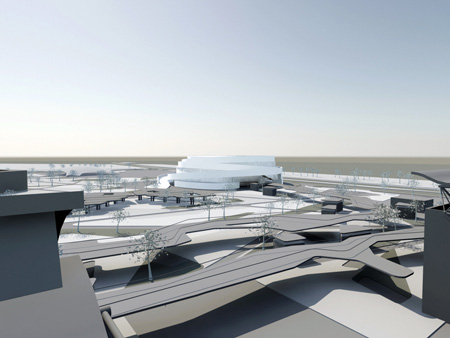
    El edificio circular acogerá una gran variedad de eventos, como conciertos de música internacional, peleas de box, eventos universitarios o espectáculos tradicionales mexicanos.

    Irapuato, Guanajuato, México

    Este escenario está equipado con la tecnología de este tipo en la acústica y la iluminación que incluso la gente sentada en las filas de atrás (por lo que 23 metros de la etapa) disfrutarán de su programa favorito.

    Vía: dezeen.com

    Irapuato-Music-Hall-and-Sports-Centre-by-Tatiana-Bilbao_016

    Irapuato-Music-Hall-and-Sports-Centre-by-Tatiana-Bilbao_015

    La forma característica exterior, como resultado del programa de interiores, también incluye bares, restaurantes y terrazas que da vida a la construcción cotidiana, aunque el interior no se utiliza.

    Este edificio situado en su INFORUM el Congreso y el parque de hadas, situado en el norte de la ciudad de Irapuato.

    Irapuato-Music-Hall-and-Sports-Centre-by-Tatiana-Bilbao_008

    Irapuato-Music-Hall-and-Sports-Centre-by-Tatiana-Bilbao_003

    Irapuato-Music-Hall-and-Sports-Centre-by-Tatiana-Bilbao_002

    Este estudio multidisciplinario tiene una arquitectura como su práctica principal, con proyectos en México y varios países alrededor del mundo.

    Además, la oficina constantemente organiza exposiciones y programas diferentes, por lo tanto la promoción de la cultura contemporánea.

    La oficina se desarrolla la arquitectura que abarca una amplia gama de tipologías, son los ejemplos principales: una casa para el artista Gabriel Orozco en el Océano Pacífico, una casa de 1388 m2 en comunidad cerrada Ordos (China), el Jardín Botánico de Culiacán o de la funeraria Tangassi en San Luis Potosí, sala de exposiciones de arquitectura en Jinhua Park y el Pabellón de México en la Expo Zaragoza 2008.

    En 1999 co-funda Tatiana Bilbao la Oficina de Laboratorio de la Ciudad de México SC (LCM).

    Desde 2004 ha sido profesora visitante en universidades como la Universidad Iberoamericana en Ciudad de México y la Universidad Andrés Bello en Santiago de Chile.

    Mexican architect Tatiana Bilbao has designed a music hall and sports centre for Irapuato, Mexico.
    Called Irapuato Music Hall and Sports Centre, the five-storey circular building would host musical and sporting events in one central hall.
    Shaped around this interior, the exterior of the building would incorporate bars, restaurants and terraces.
    More about Tatiana Bilbao on Dezeen: Biotechnological Park Building.

    Here’s some information from the architects:

    IRAPUATO MUSIC HALL AND SPORTS CENTER
    Irapuato, Guanajuato, México
    Irapuato Music Hall and Sports Center will be a multipurpose building.
    The five level circular building will host a wide variety of events, such as international music concerts, box fights, college events or traditional Mexican shows.
    This arena is equipped with such a technology in acoustics and illumination that even the people seated in the back rows (as far as 23 meters from the stage) will enjoy their favorite show.
    The exterior characteristic shape, resulting from the interior program, also includes bars, restaurants and terraces which brings life to the building everyday, even if the interior is not being used.
    This building its situated in the INFORUM congress and fairy park, located at the north of Irapuato city.
    TATIANA BILBAO S.C.
    Tatiana Bilbao S.C. was founded in 2004 by Mexican architect Tatiana Bilbao Spamer.
    This multidisciplinary studio has architecture as its main practice with projects in Mexico and various countries around the world.
    In addition, the office constantly organizes different exhibitions and programs, therefore promoting contemporary culture.
    The office develops architecture covering a wide range of typologies, being the main examples: a house for the artist Gabriel Orozco in the pacific ocean, a 1388 m2 gated community house in Ordos (China), a Botanical Garden in Culiacan or the Tangassi funeral home in San Luis Potosi, an Exhibition Room in Jinhua Architectural Park and the Mexican Pavilion for the Expo Zaragoza 2008.
    In 1999 Tatiana Bilbao co-founds the Office Laboratorio de la Ciudad de Mexico S.C.(LCM).
    Since 2004 she has been a visiting professor in Universities such as Universidad Iberoamericana in Mexico City and Universidad Andres Bello in Santiago de Chile.
    In 2007 Tatiana Bilbao was recognized by Design Vanguard Prize for being one of the 10 most influential, young practices of the world.