Archived entries for American Architecture

Dominey Pavilion de Lightroom Studio

Dominey-Pavilion-por-Lightroom-Studio_004

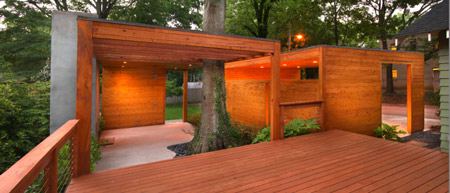
Los Arquitectos del Estudio Lightroom de Georgia han completado un salón al aire libre, construido alrededor de un árbol en una casa en Atlanta, EE.UU..

Llamado Dominey Pabellón, la estructura de madera extiende la casa existente mediante la adición de una serie de terrazas, salas, pantallas, un garaje y un camino de entrada.

Dominey-Pavilion-por-Lightroom-Studio_003

Dominey-Pavilion-por-Lightroom-Studio_002

En el centro del pabellón se encuentra una chimenea con asientos, formando una sala que está abierta a tres lados.

Vía dezeen.com

Más información de los arquitectos:

El Pabellón de Dominey consiste en una cochera, estacionamiento, la cubierta exterior, sala de estar al aire libre, y jardín.

Los clientes son los defensores del programa “Case Study House” de la década de 1940 y como la obra de Alvar Aalto, Richard Neutra, y Donald Judd, por lo tanto se deja influir en el diseño.

Dominey-Pavilion-por-Lightroom-Studio_001

Dominey-Pavilion-por-Lightroom-Studio_1

Dominey-Pavilion-por-Lightroom-Studio_005

El proyecto difumina los límites entre la escultura minimalista, arquitectura y paisaje a través de características como la chimenea al aire libre y la lengua plana que define las salas al aire libre.

La chimenea Semperian crea una referencia a las casas de la campiña de Georgia y define la sala de estar al aire libre. De entrada arbolada que cuidadosa se diseñó y aplicado para el árbol de roble blanco existente, que atraviesa el techo. Los materiales de construcción y las decisiones se realizaron en cumplimiento de LEED.

Materiales: ciprés, estuco capa galvanizada con bordes duros de cuentas, reciclado de bloques de concreto, bloques de hormigón poroso (que permite el crecimiento de las raíces y la penetración de agua, luces halógenas empotradas.

Dominey-Pavilion-por-Lightroom-Studio_002 Dominey-Pavilion-por-Lightroom-Studio_001 Dominey-Pavilion-por-Lightroom-Studio

Architects Lightroom Studio of Georgia have completed an outdoor living room, built around a tree at a house in Atlanta, USA.

Called Dominey Pavilion, the wooden structure extends the existing house by adding a series of decks, rooms, screens, a garage and a driveway.

Central to the pavilion is a fireplace with seating, forming a living room that’s open on three sides.

Here is some more information from the architects:

The Dominey Pavilion consists of a carport, driveway, exterior deck, outdoor living room, and garden.

The clients are proponents of the Case Study House program of the 1940s and like the work of Alvar Aalto, Richard Neutra, and Donald Judd, thus influencing the design.

The project blurs the boundaries between Minimalist Sculpture, Architecture, and Landscape through features like the outdoor fireplace and the planar language that defines the outdoor rooms.

Abstract references to the southern vernacular of shotgun shacks and dogtrot houses are other influences to the design. The carport and pavilion reference dogtrot houses allowing southeast breezes to flow through.

The Semperian fireplace creates a cross reference to the burnt-out houses of the Georgia countryside and defines the outdoor living room. Careful arborist input was sought and implemented for the existing white oak tree, which pierces the the roof. Materials and construction decisions were made in compliance with LEED.

Materials: Georgia 4-inch tongue and groove cypress, hard coat stucco with galvanized bead edges, recycled concrete blocks, porous concrete slabs (to allows for root growth and water penetration, 4-inch recessed halogen lighting.

Guggenheim NY celebra 50 años

museum-Guggenheim-frank-lloyd-wright-new-york_005

Guggenheim es un arte en sí mismo.

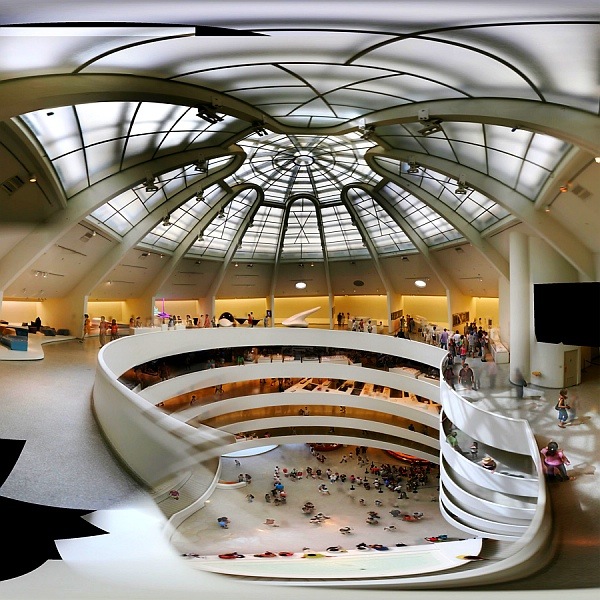
Cuando el propietario del nombre es retirado de su propia compañía en 1919, estaba lejos de pensar que su hobby de coleccionista de arte le convertiría en el creador de una de las mayores fundaciones en el mundo del arte y uno de los museos más importantes del arte contemporáneo: el Museo Solomon R. Guggenheim.

museum-Guggenheim-frank-lloyd-wright-new-york_001

museum-Guggenheim-frank-lloyd-wright-new-york

Vía : networkedblogs.com

Frank Lloyd Wright recibió el encargo de diseñar este edificio, y después de 700 bocetos, presentó el proyecto final, que finalmente no solo sería una de sus últimas obras, sino también una de los más populares. El arquitecto murió seis meses antes de consumada la inauguración del edificio, así como el creador de la fundación, que murió 10 años antes del evento.

Como muchas de las creaciones de Wright, el Guggenheim destaca por su arquitectura de  vanguardia y ecológica dada a los valores de los espacios abiertos, mucha luz natural. En sus propias palabras “en comparación con el Guggenheim, el Museo Metropolitano de Arte se parece a un establo protestante.”

A pesar de las quejas, incluyendo el New York Times que lo consideró una repetición de la arquitectura y la pintura, el museo se ha convertido en un referente del arte contemporáneo, y se amplió en 1992. Hoy en día, la fundación ha crecido y también hay museos Guggenheim en Venecia, Berlín y Bilbao, que establecen el culto del arte no-objetivo. También hay planes para construir más museos en Abu Dhabi (Emiratos Árabes emigrantes), Guadalajara (México) y  Vilnius (Lituania).

El museo celebra el aniversario de oro con dos exposiciones especiales durante todo el año: las adquisiciones para la inauguración de 1959 y Kansinsky, está última todavía en curso.

museum-Guggenheim-frank-lloyd-wright-new-york_004

museum-Guggenheim-frank-lloyd-wright-new-york_003

museum-Guggenheim-frank-lloyd-wright-new-york_006

Guggenheim is an art in itself. When the owner of the name is removed from his own company in 1919, was far from thinking that his hobby of art collector would make him the creator of a of the largest foundations in the world of art and one of the most important art museums contemporary Museum Solomon R. Guggenheim.

Frank Lloyd Wright was commissioned to design this building, and after 700 sketches, presented the final project, which eventually would be not only one of his last works, but also one of the most popular. The architect died six months before the inauguration of the building accomplished and the creator of the foundation, who died 10 years before the event. Like many of Wright’s creations, the Guggenheim is notable for its avant-garde architecture and ecological values given to open spaces, abundant natural light. In his own words ” compared with the Guggenheim, the Metropolitan Museum of Art is like a Protestant barn. ”
Despite the complaints, including the New York Times that he considered a repetition of the architecture and painting, the museum has become a landmark of contemporary art, and was expanded in 1992. Today day, the foundation has grown and there are Guggenheim museums in Venice, Berlin and Bilbao, which establish the cult of nonobjective art. There are also plans to build more museums in Abu Dhabi (United Arab emigrants), Guadalajara (Mexico) and Vilnius (Lithuania).
The museum celebrates the golden anniversary with two special exhibitions throughout the year: the procurement for the opening of 1959 and Kansinsky, the latter still ongoing.