Archived entries for arquitectura sostenible en japon

Casa en Koamicho por Suppose Design Office

Casa-Koamicho-por-Suppose-design-office_002

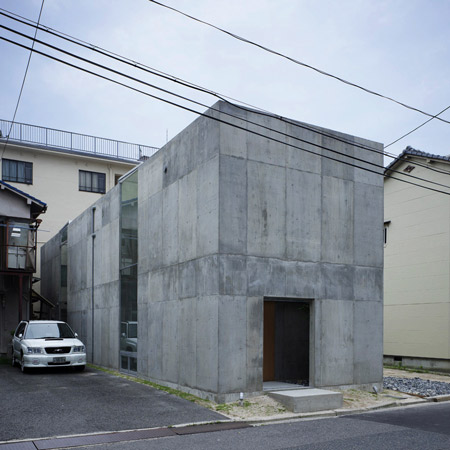
Los arquitectos japoneses Suppose Design Office han completado una casa en Hiroshima, Japón, donde los residentes se mueven entre habitaciones a través de patios cubiertos.

Casa que llamada Koamicho, es residencia de dos plantas y está situada en una parcela larga y estrecha.

English text at the end

Dos plazas de cristal entre las habitaciones están plantadas con árboles pequeños y procuran romper la sucesión de habitaciones, ofreciendo visiones del exterior.
Los dormitorios están ubicados en la planta baja con cocina, comedor y salas de estar en el primer piso.

Casa-Koamicho-por-Suppose-design-office_013 Casa-Koamicho-por-Suppose-design-office_012 Casa-Koamicho-por-Suppose-design-office_011 Casa-Koamicho-por-Suppose-design-office_010

La siguiente información es de Suppose Design Office :

Casa en Koamicho

Cuando normalmente se dice “interior” o “exterior”,
¿cuáles son las causas? ¿Y cuáles son las causas de la sensación de “abierto” o “estrecho”?

Esta casa está diseñada con mucha atención a cómo, desde las causas, se definen las condiciones de un espacio.

En un espacio largo y estrecho, construimos muros, y por un espacio en el que experimentamos muchas habitaciones, que a su vez “estrechez” en “la apertura.
“Además, teniendo en habitaciones y jardines como equivalentes, hemos creado espacios que son como los exteriores, llamándolos” salas de jardín “.

Casa-Koamicho-por-Suppose-design-office_009 Casa-Koamicho-por-Suppose-design-office_008 Casa-Koamicho-por-Suppose-design-office_007 Casa-Koamicho-por-Suppose-design-office_006 Casa-Koamicho-por-Suppose-design-office_005 Casa-Koamicho-por-Suppose-design-office_004

Al cambiar de habitación a otra habitación, alternativamente, puede experimentar el interior y exterior, y se convierten en el lugar donde todas las habitaciones están conectados con el exterior.
Aquí hemos tenido éxito en la realización de un espacio, que pasan de las definiciones tradicionales  una nueva relación entre – interior y exterior.

Japanese architects Suppose Design Office have completed a house in Hiroshima, Japan, where residents move between rooms through covered courtyards.

Called House in Koamicho, the two-storey residence is situated on a long narrow plot.

Two glazed spaces between rooms are planted with small trees and break up the succession of rooms, affording glimpses of the outside.
Bedrooms are located on the ground floor with kitchen, dining and living areas on the first floor.

Vía dezeen.com
The information below is from Suppose Design Office:

House in Koamicho

When we normally feel “interior” or “exterior”, what are the causes? And what are the causes of feeling “open” or “narrow”?
This is house designed with much thought to how, from those root causes, we define the conditions of a space.

In a long, narrow space, we constructed walls, and by laying out a space in which we experience many rooms, we turn “narrowness” into “openness.
“Further, taking rooms and gardens as equivalent, we created spaces that are like the exteriors, calling them “garden rooms”.

By moving from room to another room, we can alternately experience interior and exterior, and they become the place where every rooms are connected to the exterior.
Here we have succeeded in realizing a space, which pass traditional definitions tomaterialized a new relationship between – interior and exterior.

Casa-Koamicho-por-Suppose-design-office_003 Casa-Koamicho-por-Suppose-design-office_001 Casa-Koamicho-por-Suppose-design-office Casa-Koamicho-por-Suppose-design-office_014

Ewha Woman’s University de Dominique Perrault

architecture-in-japan-Ewha-Womans-University_009

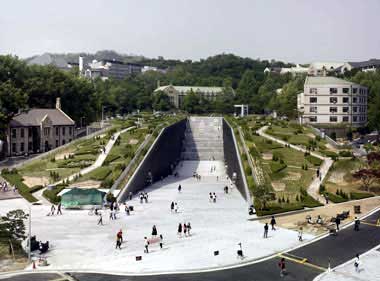
La complejidad del sitio, a través de su relación con el mayor campus y la ciudad de Shinchon, exigió una “más grande que el sitio” La respuesta, una respuesta urbana, una solución global de jardines, tejiendo el tejido de los campus de Ewha con la de la ciudad .

English text at the end.

Rebanadas de costura a través de la topografía revelan el interior del centro del campus Ewha. Un vacío transforma el campus “valle”, donde la naturaleza, campos de deportes, locales para eventos educativos y edificios se entremezclan y se suceden.

architecture-in-japan-Ewha-Womans-University_009

El suavemente descendente “valle” conduce a una escalera monumental por el centro del campus, que reúne a los diferentes niveles de los edificios.

Vía arcspace.com

architecture-in-japan-Ewha-Womans-University_026 architecture-in-japan-Ewha-Womans-University_024

Los dos grandes muros cortina de cristal frente a la rampa de circulación externa sirven como elementos para dar luz del día y permitir la ventilación natural de las partes del edificio.

El carácter pastoral del campus, con árboles, flores y hierba que cubre el centro del campus, es quizás su característica más notable. La idea de entrelazar el campus es de nuevo evidente, borrando la distinción entre el edificio antiguo y nuevo, y el paisaje, presente y pasado.

architecture-in-japan-Ewha-Womans-University_023 architecture-in-japan-Ewha-Womans-University_021 architecture-in-japan-Ewha-Womans-University_019 architecture-in-japan-Ewha-Womans-University_018 architecture-in-japan-Ewha-Womans-University_016

Perrault considera que “el concepto y la materia tienen que luchar entre sí.”


Sus diseños se han enterrado, excavados, o los encuentra – como la Biblioteca Nacional de Francia en París y el Velódromo y piscina olímpica en Berlín. La idea de esta universidad subterránea nació del deseo de preservar un espacio verde de grandes dimensiones en el centro del campus universitario.

El vínculo entre el concepto de arquitectura sostenible y las estrategias adoptadas – edificio subterráneo, jardín verde, fractura de paisaje – le da una fuerte identidad al edificio y permitir  extraordinarios resultados en términos de sostenibilidad.

architecture-in-japan-Ewha-Womans-University_001

“Un foro para el intercambio de ideas, que los estudiantes se reúnen después de clases para discutir sus puntos de vista, una plaza, con cafetería fuera, creando un verdadero ” lugar ” para parar y descansar, un teatro al aire libre, la escalera se puede utilizar como un anfiteatro, un jardín de esculturas, donde los acontecimientos de galería interior se puede empujar hacia el exterior. Es esta flexibilidad (conceptual y real) que permite el centro Ewha, inevitablemente, tejer en el paisaje – a veces de un edificio, a veces un paisaje, a veces una escultura. ”
Dominique Perrault

architecture-in-japan-Ewha-Womans-University_013 architecture-in-japan-Ewha-Womans-University_011


The complexity of the site, through its relationship to the greater campus and the city of Shinchon, demanded a “larger than site” response, an urban response, a global landscaped solution, weaving together the tissue of the EWHA campus with that of the city. A new seam slices through the topography revealing the interior of the EWHA campus center. A void is formed, a campus “valley” where nature, sport grounds, event locations and educational buildings mix, intermingle and follow one another. The gently descending “valley” leads to a monumental stairway through the campus center, bringing together the different levels of the buildings. The two large glass curtain walls facing the external circulation ramp serve as elements for daylight and allow for natural ventilation of parts of the building as well. The pastoral nature of the campus, with trees, flowers, and grass covering the campus center, is perhaps its most remarkable quality. The notion of weaving together the campus is again evident, blurring the distinction between old and new, building and landscape, present and past. Perrault believes that “concept and matter have to grapple one another.” His designs are often buried, excavated, or nestled places – like the French National Library in Paris and the Velodrome and Olympic swimming pool in Berlin. The idea of this underground university was born out of the desire to preserve a large green space in the center of the university campus. The link between the architectural concept and the sustainable strategies adopted – underground building, green garden, landscape fracture – gives a strong identity to the building and enable extraordinary performances in terms of sustainability. “A forum for the exchange of ideas as students gather after class to discuss their views, a piazza, with the cafeteria spilling out, creating a real “place” to stop and relax, an outdoor theater, as the stair can be used as an amphitheater, a sculpture garden, where indoor gallery events can push outwards. It is this flexibility (conceptual and real) which permits the new EWHA campus center to inevitably weave itself into the landscape – sometimes a building, sometimes a landscape, sometimes a sculpture.” Dominique Perrault